

Poe, Quora’s innovative platform that unifies various AI models, has unveiled a new feature that empowers users to create visual interfaces—essentially apps—leveraging any combination of these models.
Dubbed Poe Apps, this functionality enables users to specify the applications they wish to develop using the newly introduced App Creator tool. Users can provide detailed descriptions that may include specific models they intend to utilize, such as OpenAI’s o3-mini or Google’s video-generating Veo 2, or more general requirements.

The App Creator, powered by Anthropic’s newly introduced Claude 3.7 Sonnet, converts user input into the app’s interface code along with custom logic defined in JavaScript. Poe Apps can function alongside the Poe chatbot interface or operate entirely visually, with their underlying code available for manual tweaking and refinements.
Quora has developed a few prototype apps, including one that converts photos into 3D anime-style artwork using OpenAI’s GPT-4o and Black Forest Labs’ Flux-Pro-1.1. Another showcases object removal from images, utilizing Bria’s Bria-Eraser model.
Currently, Poe Apps can be shared exclusively among Poe users on the web, with mobile support on iOS and Android anticipated soon, according to Quora. Each time an app executes an AI model, it will utilize points from the user’s balance within Poe. Free users are allotted a daily point quota, while those subscribed to Poe’s premium plan at $9.99 per month can choose flexible daily or monthly point packages.
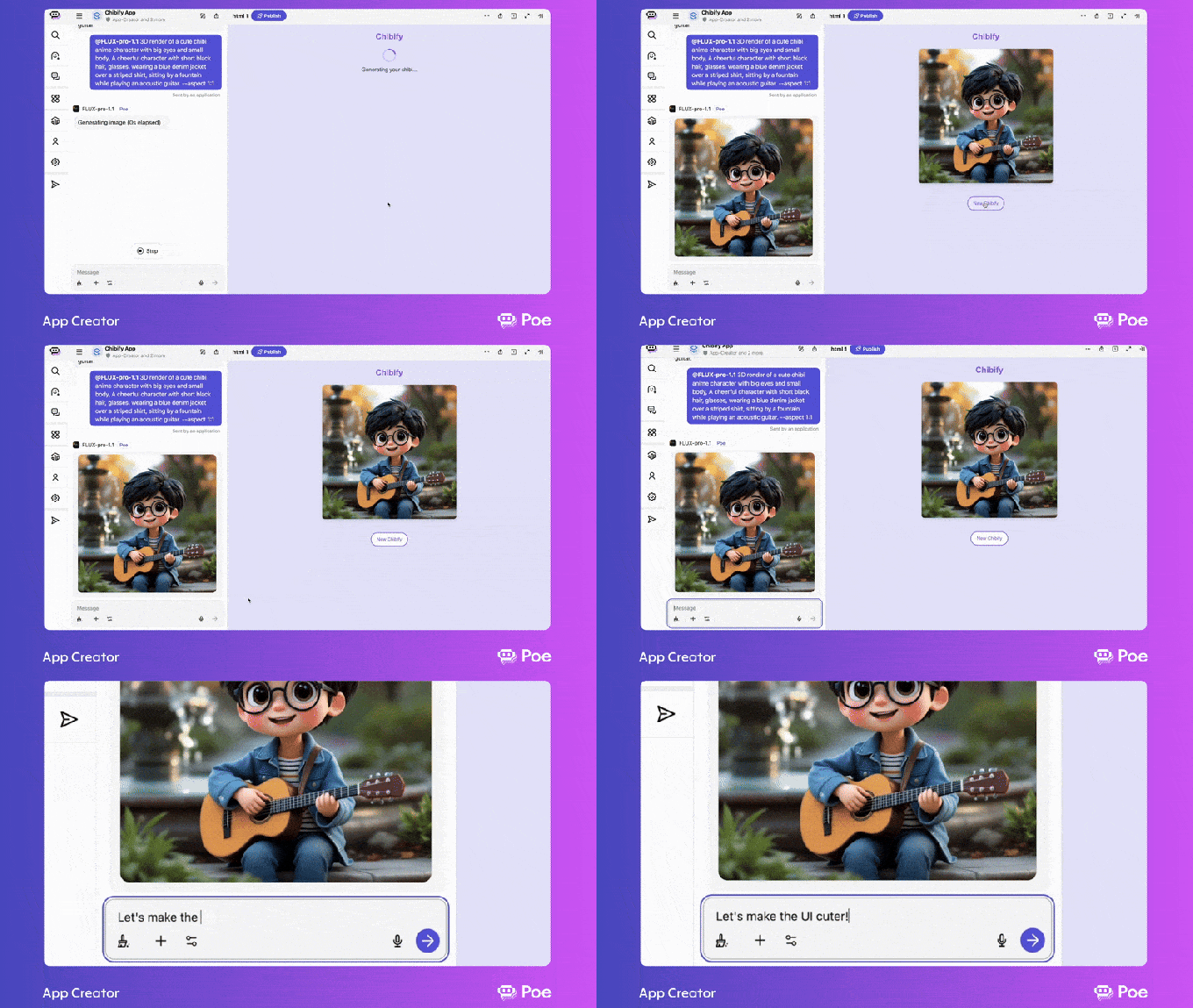
In a blog post, Quora mentioned the App Creator is temporarily available at a special early-access price and hinted at potential monetization features for the applications.
Quora stated, “This is just the initial launch, and we have an extensive roadmap ahead to empower creators further, including options to earn income directly through their applications. We can’t wait to see what you all develop. We’re also excited about enhancing Poe Apps as model performance improves this year.”
Poe Apps build upon the web apps functionality that was introduced last July, resembling Anthropic’s Artifacts and OpenAI’s ChatGPT Canvas tools, which offer dedicated environments for users to modify and augment AI-generated outputs like code and documents. Although the applications produced by these tools are somewhat limited, they undeniably showcase the advancements that have been made in AI programming capabilities.
Compiled by Techarena.au.
Fanpage: TechArena.au
Watch more about AI – Artificial Intelligence

