

Planera, an emerging company in the construction-technology sector that provides software solutions for planning and scheduling commercial construction endeavors, has successfully secured $13.5 million during its latest funding initiative.
Traditionally, general contractors have relied on older software models like Oracle Primavera P6 for handling commercial construction projects. Although these platforms are equipped for complex, long-term projects featuring numerous critical milestones, they demand significant technical savvy and lack user-friendly interfaces. For smaller-scale projects, contractors might turn to a more general tool such as Microsoft Project. However, these options often fail to address the specific needs of a construction operation fully.
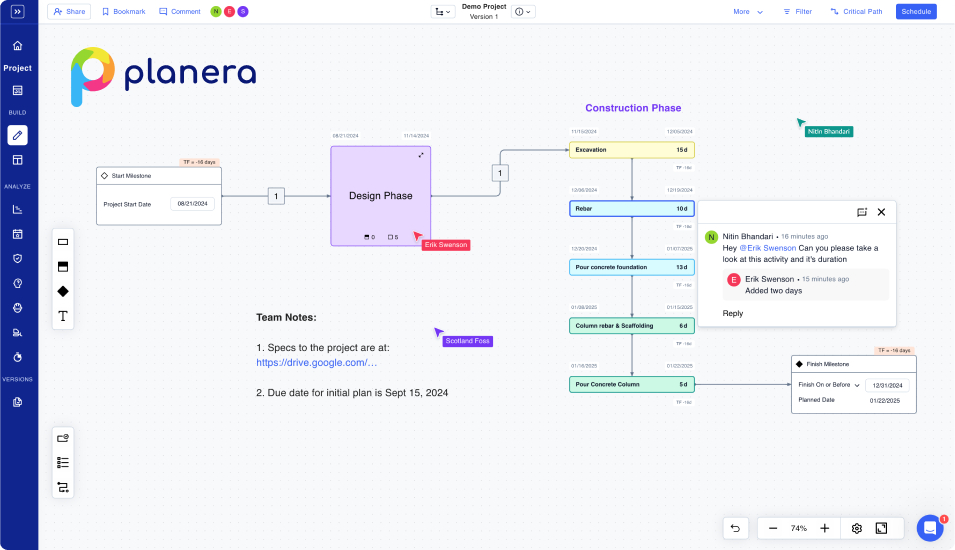
The innovative startup from San Jose bridges the gap by introducing a proprietary software platform designed to aid contractors in managing both extensive and brief projects with a digital interface that resembles a whiteboard, facilitating instantaneous collaboration. Given the industry’s sensitivity to scheduling due to the commonality of liquidated damages and stringent contractual requirements, having the ability to track and manage deadlines efficiently is indispensable. Contractors, therefore, commonly juggle several software options to monitor their project’s progress.
Planera enables direct collaboration amongst contractors on a project, streamlining workflow through a unified platform.
“Planera’s true worth lies not solely in plan development but equally in its competency as an excellent tool for communication,” noted Nitin Bhandari, Planera’s co-founder and CEO, during an exclusive chat.
The service allows general contractors to draft, evaluate, and fine-tune their construction schedules, ensuring alignment with contractual requirements and timelines. It further includes compatibility with widely utilized platforms such as AutoDesk and Procore, allowing for seamless schedule synchronization without necessitating app switching.
Bhandari shared with TechCrunch plans to extend the software’s utility to subcontractors, as general contractors frequently collaborate with these entities for specialized tasks, including electrical and mechanical work.
“As the construction industry progresses in modernizing various business areas to reap attendant benefits, the emphasis has now shifted towards updating all crucial operational facets, with project scheduling and planning becoming key focal points,” he elaborated.
Planera distinguishes itself among numerous construction-focused startups due to the success of its founding members in prior ventures. Prior to Planera, Bhandari co-founded the mobile browser business Skyfire and the screen-time management app ZenScreen, which Life360 later acquired, before venturing into Planera in November 2021.
The conception of Planera was inspired by a discussion with Saif Lodhi, owner of California Engineering Contractors for nearly three decades. Initially approached for assistance in modernizing Lodhi’s company, Bhandari quickly realized the industry-widespread issue with scheduling. To tackle this challenge, he enlisted Erik Swenson, former CTO of Skyfire for over a decade, to co-found Planera.
As of now, Planera boasts a clientele of over two dozen, utilizing its platform across more than 500 ongoing projects.
The series A funding round of Planera, entirely equity-based, was led by Sierra Ventures, and saw contributions from Sorenson Capital, Brick and Mortar Ventures, Prudence VC, and Firebolt Ventures.
Bhandari revealed to TechCrunch that the plan is to allocate 60% of the newly acquired funds towards amplifying sales and marketing efforts, with the remainder targeted at R&D and further product enhancements. An anticipated innovation involves integrating AI tailored for the construction arena to augment the efficiency of scheduling and planning operations.
“We aim to develop our proprietary data models and assistant functionalities, which are slated for rollout by year’s end and into the early months of next,” he disclosed.
Without disclosing precise revenue figures, Bhandari projected a 5-8 fold increase in earnings compared to last year’s fourth quarter. The remotely operated startup currently employs a 30-person team spanning various markets, including Bengaluru, India, with ambitions to expand the workforce to between 45 to 50 members in the upcoming six months.
Compiled by Techarena.au.
Fanpage: TechArena.au
Watch more about AI – Artificial Intelligence
