
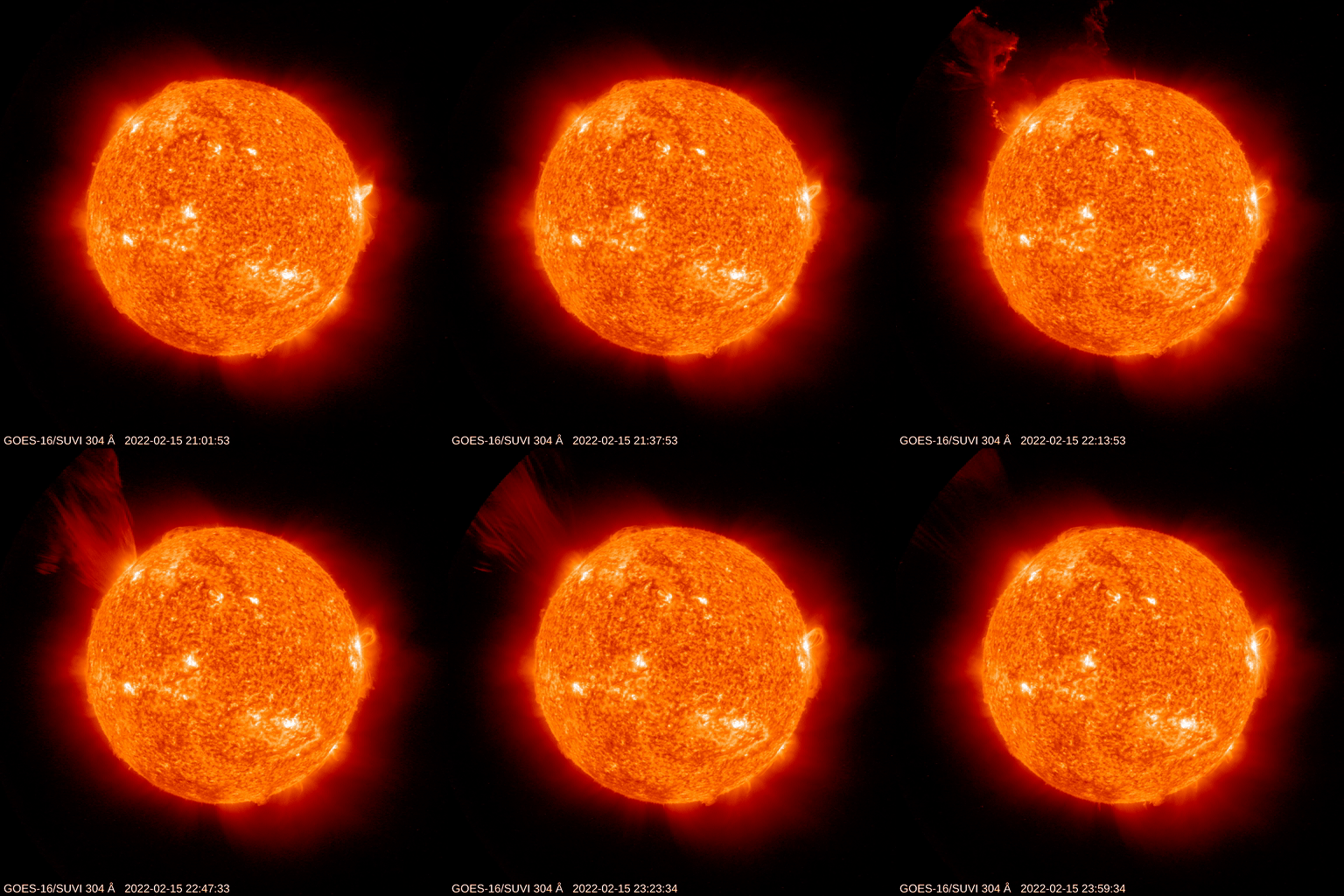
Accurate forecasts of space weather phenomena such as solar storms and geomagnetic disturbances are crucial for rocket launch firms, satellite service providers, and aviation industries to manage their operations effectively. However, most of this crucial data comes from government agencies using outdated modeling methods.
Enter Perspective Space, a Canadian newcomer that stepped out of the shadows on Tuesday, aiming to revolutionize the field. The startup bets on leveraging advancements in artificial intelligence and machine learning to enhance the precision of space weather predictions and ensure updates are delivered almost instantly.
Behind the company is founder Padmashri Suresh, an engineer with a background in rocket and cubesat missions from Utah State University, who went on to pursue a NASA-supported PhD focusing on the intersection of space weather and machine learning. Suresh experienced the repercussions of unreliable space weather forecasts on space missions and instruments first-hand. After her academic journey, she entered the tech field, biding her time until the conditions were ripe for starting her venture in space weather.
“The moment came in 2022 when SpaceX lost roughly 38 to 40 satellites to space weather,” she recalls. “This incident convinced me it was time to take action and found my own company.”
The issue of space weather catapulted into the limelight again last year after an unexpected solar maximum wreaked havoc on satellite operations more severely than anticipated.
While NASA and NOAA rely on satellite, radar, and ground-based magnetometers to collect space weather data and use heavy, physics-based models requiring supercomputers for prediction, Suresh recognizes the challenge at hand. “It’s a daunting task,” she admits.
“The physics involved spans various scales. One must grasp the dynamics of the sun and the entire space environment extending from the Sun to Earth. Numerous factors influence the space weather we experience,” she explains.
However, Suresh is optimistic that AI can unlock more insights from data, driven by more accessible high-performance computing and breakthroughs in predictive algorithms, coupled with the influx of data from an increasing number of low Earth orbit satellites.
With $2.8 million in backing from investors like Panache Ventures, Metaplanet, 7Percent Ventures, Mythos Ventures, and AIN Ventures, Perspective Space is poised to expedite its journey from a laboratory prototype to a comprehensive service for both launchers and satellite operators in any orbit by next year. The investment will primarily support the expansion of the company’s workforce from 5 to 10 employees within a year.
Perspective Space has already initiated a pilot program and registered early users who are providing valuable feedback. The company plans to enroll more participants into this program. Upon the commercial rollout, it will offer subscription-based forecasts with a variety of pricing options tailored to the volume of assets and specific orbits among other criteria.
Looking ahead, Suresh emphasizes the critical role of precise space weather information in supporting the proliferation of satellites in lower orbits and sustaining human activities in space. From guiding International Space Station mission decisions to informing SpaceX launch schedules and assessing radiation risks for pilots, she underscores the significance of considering the human element in space weather impacts.
“The human aspect is pivotal,” she remarks.
Compiled by Techarena.au.
Fanpage: TechArena.au
Watch more about AI – Artificial Intelligence

