

Transforming into a data-driven entity remains a challenging journey for many companies, despite their determination to achieve this objective. Even teams specialized in data analytics find it difficult to leverage data effectively. A Gartner report reveals that less than 50% of data and analytics leaders believe their teams successfully deliver value to their companies.
The gap in effectively implementing data analytics was recognized by Michael Berthold, a German computer scientist, during his tenure as a professor at Konstanz University. In his interactions with businesses aiming to utilize data analytics, a common need for a comprehensive platform to process and analyze data was articulated, Berthold shared with TechCrunch, leading him and his peers to embark on developing such a solution.
Berthold aimed to foster a modular, easily scalable open data platform with seamless integrations across various data handling, analyzing, transforming, and visualizing components, without limiting to a specific use case. The ambition was for the software not only to meet professional standards but also to provide a cohesive framework for a broad spectrum of data analysis endeavours.
This vision culminated in the creation of the open source tool, KNIME, co-founded by Berthold, Bernd Wiswedel, and Thomas Gabriel, which evolved into a venture capital-supported enterprise. Nowadays, KNIME serves 400 corporate clients with its premium platform version, boasting names like Audi, AMD, and Bayer among its users, and reports an annual growth rate of 30-40% in recurring revenue since its inception in 2008, amounting to roughly €30 million.
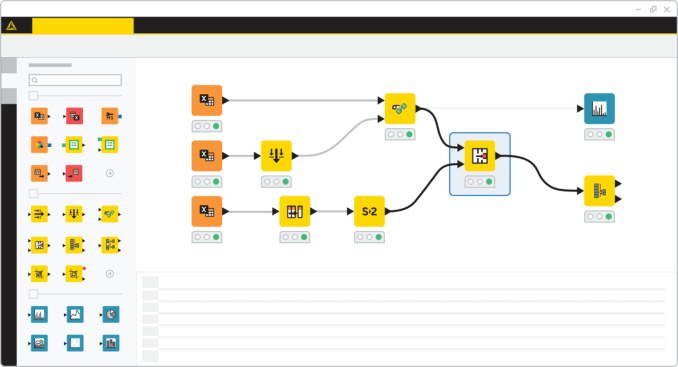
KNIME has championed a visual, no-code interface that allows businesses to seamlessly connect with their existing record systems. It supports the construction of data transformation pipelines, analytics, and visual reports, facilitating comparison across different data sets irrespective of their storage locations.
Its business hub enables execution, automation, and deployment of data workflows, bolstered with options for governance and security. This hub also fosters the creation and sharing of internal workflow libraries within organizations, or the adoption of workflows from the KNIME community.
Despite its significant license fee starting at $39,900 for the business hub, KNIME’s client base remains robust and growing—drawing attention from investors.
Recently, KNIME secured a $30 million investment from Invus, raising its total funding to $50 million. The investment is earmarked for product innovation, team expansion from 250 to 275 members before year-end, and broadening the customer base in the U.S., Europe, Middle East, and Africa, explained Berthold.
In facing competition from other data analytics platforms like Dataiku and Alteryx, Berthold highlighted KNIME’s edge with its new AI assistant for enhancing data projects and the strategy to expand its SaaS offerings, aiming at small- to medium-sized enterprises with flexible pricing models.
Berthold remarked that while approaching profitability in 2024, KNIME opted to prioritize growth and investment despite a general slowdown in tech, marked by longer sales cycles and tougher negotiations. However, the sustained interest in open source analytics platforms places KNIME in a favorable position for future growth.
Compiled by Techarena.au.
Fanpage: TechArena.au
Watch more about AI – Artificial Intelligence
