
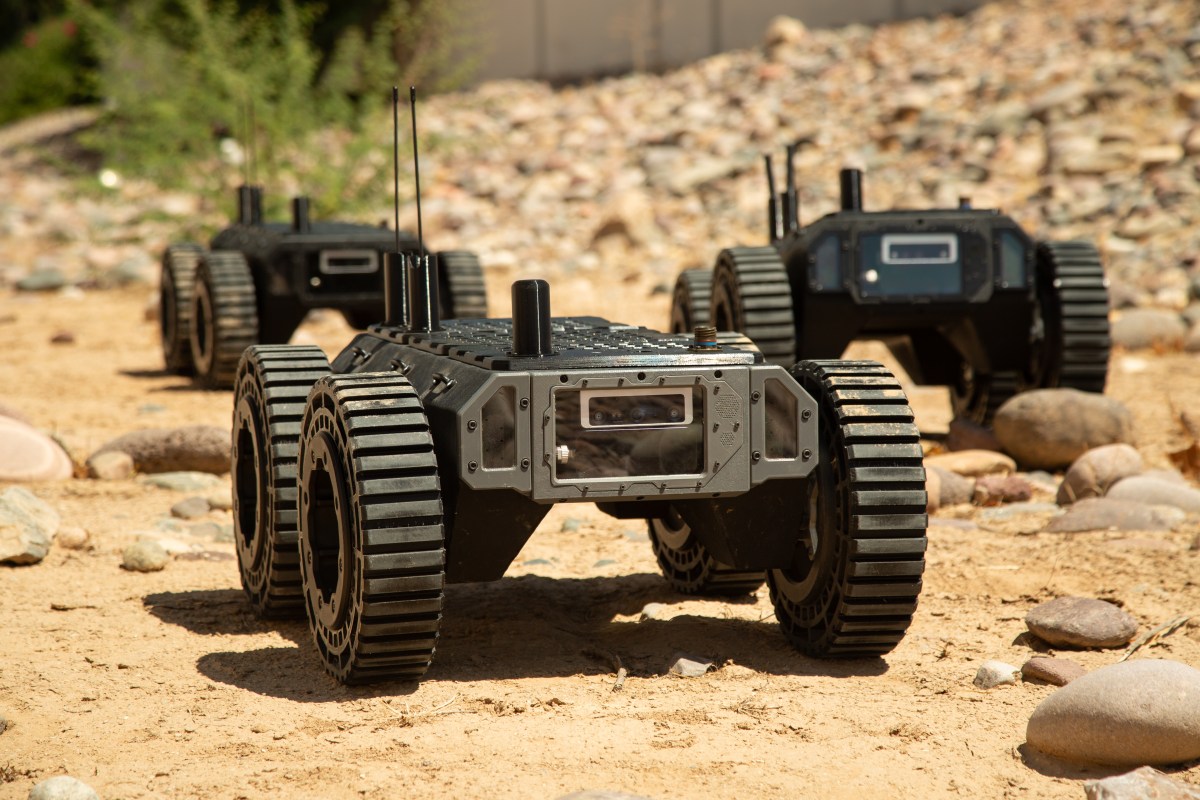
While the battlefield has seen limited use of fully autonomous systems, a new startup is setting the stage for a revolution with its development of robotic swarms that enhance the intelligence and tactical capabilities of military forces. These swarms consist of self-coordinating autonomous robots designed to work collectively.
Previously confined to the realms of science fiction, swarm robotics is being turned into a tangible reality by Swarmbotics AI. The company has recently emerged, introducing a suite of products known as ANTS (Attritable, Networked, Tactical Swarm), aimed at revolutionizing how military logistics are managed on the battlefield.
Stephen Houghton and Drew Watson, who co-founded Swarmbotics last summer, crossed paths at Embark Trucks—a firm specializing in autonomous trucking—where Houghton served as COO and Watson oversaw product operations.
The duo boasts extensive experience in robotics: Houghton, a Marine Corps officer, was pivotal in the growth of Cruise, an autonomous vehicle firm acquired by General Motors, seeing it expand from a small team to thousands of employees. He later led Amazon Web Services in autonomous vehicle and robotics ventures. Watson, on the other hand, contributed significantly at the CIA before moving to NASA’s Jet Propulsion Laboratory, where he led software development for the Valkyrie Humanoid Robot program.
Following the acquisition of Embark by Applied Intuition, they embarked on their Swarmbotics venture.
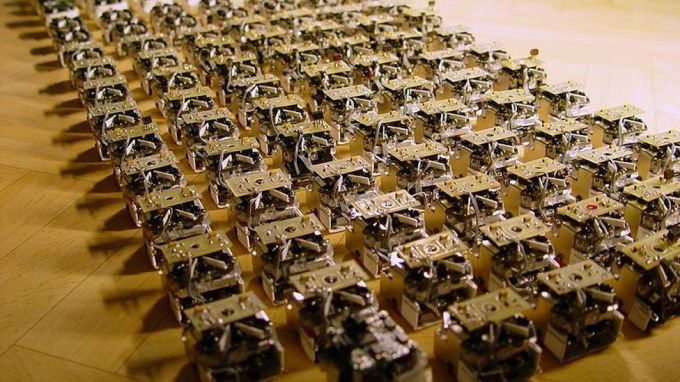
Houghton shared their fascination with robot swarms, driven by the realization that the industry heavily invested in creating high-cost autonomous systems requires perfect operation within human environments. They envisaged applications for more affordable robots that could be deployed en masse with speed.
While swarm robotics is a burgeoning field, primarily explored in academic circles and not yet widely applied in military contexts, its potential remains vast. For example, despite extensive drone use in conflict zones like Ukraine, these machines largely rely on human operation and lack autonomous collective behavior.
Swarmbotics is concentrating on ground-based robotic platforms, introducing two main models: the hybrid-electric, autonomous ATV known as Haul ANT, and the more compact 60-pound Fire ANT. These platforms are designed as versatile “rolling batteries” that can be equipped with various payloads to meet a range of operational needs, from surveillance to medical evacuation, thereby offering vast flexibility for defense department applications, according to Houghton.
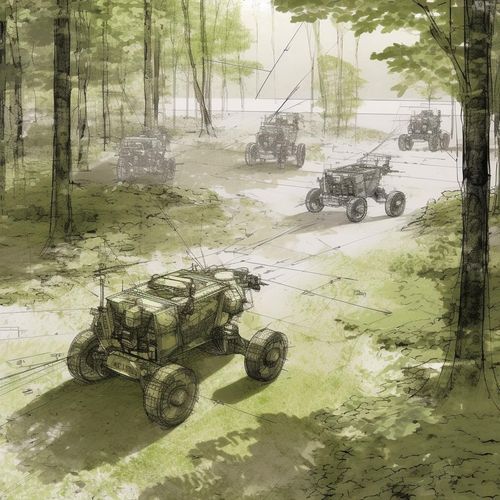
Houghton highlighted the advantage of deploying affordable robots in large numbers, allowing for rapid proliferation and the execution of diverse swarm strategies. This approach contrasts with the focus on acquiring high-end, expensive technology, favoring instead cost-effective solutions that enable scalability.
The Department of Defense (DOD) has been pushing towards adopting less expensive systems in large quantities through initiatives like Replicator. This marks a significant strategic pivot, aiming for affordability without sacrificing functionality, Houghton explained.
Having secured over $4 million in funding from investors such as Quiet Capital and LMNT Ventures, Swarmbotics is primarily channeling these resources into engineering, with a vision to eventually serve both military and commercial sectors.
With a team of 11, the company has developed its initial ANTS platforms and is now focused on enhancing the technology to improve the autonomy of individual robots, expanding the capabilities of the swarm. The objective is to provide a set of operational strategies (or “plays”) that users can execute, optimizing the robots’ performance for specific tasks.
“As we continue to embed more agents into our swarms, we begin to unveil the true potential of these systems,” Houghton concluded.
Compiled by Techarena.au.
Fanpage: TechArena.au
Watch more about AI – Artificial Intelligence
