

After a lengthy wait of nine years, Google has finally unveiled an update to the product that originally put Nest on the map. The tech giant announced on Tuesday the introduction of the Nest Learning Thermostat 4, coming 13 years after the debut of the first model and almost ten years following the Learning Thermostat 3.
With this new launch, Google aims to herald a rejuvenation of its smart home strategy. The preceding years have been characterized by a noticeable deceleration in activity from Google, prompting speculation that the sector might have hit a standstill. This phase of inactivity for the Nest series occurred alongside a similar quiet period for Amazon’s Echo range.
The timing of the Learning Thermostat’s latest iteration aligns with Google’s increased efforts in developing its generative AI model, Gemini. Although it seems poised to take the place of Google Assistant across Pixel and other Android platforms, the brand remains for the smart home segment, now enhanced by Google’s advanced LLM-based models.
Gemini aims to heighten the Assistant’s ability for dialogues. Generative AI holds the capacity to enable the sort of fluid natural language interactions that both Google and Amazon have sought to perfect for more than ten years.
As Google outlines in a statement, “We’re excited to reveal the ways in which we’re applying Gemini models to enhance our devices, making them more intelligent and user-friendly, beginning with cameras and home automation. Furthermore, these models are being used to advance Google Assistant’s interaction to be more coherent and useful across your Nest devices.”
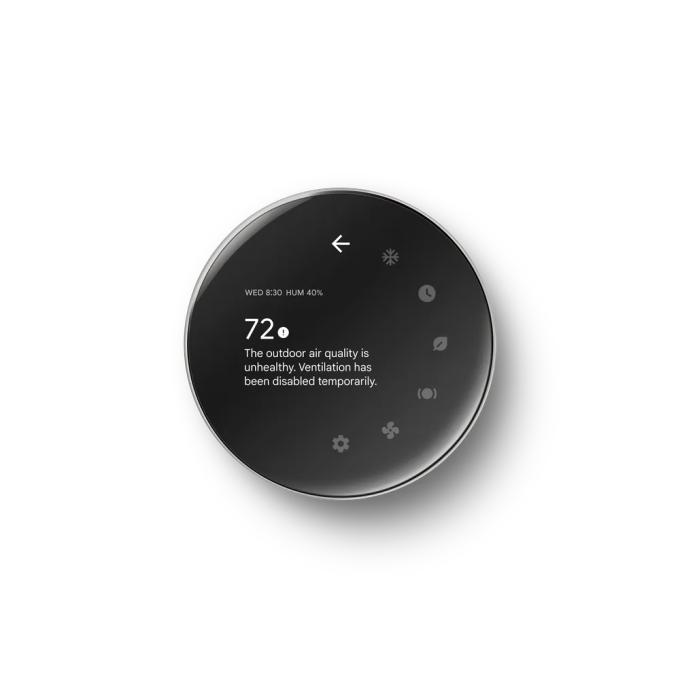
This fourth iteration polishes the familiar aesthetics of the series, presenting a slimmer and more refined look. Its always-on display now offers greater customization, debuting with four distinct faces that provide additional contextual information when approached by someone, displaying time, temperature, and air quality data.
Google decided against adding touch capabilities to the display, opting instead to retain the iconic rotatable dial interface. The display is now 60% larger than that of its third-generation predecessor, boasting an edge-to-edge layout that abandons the previous model’s thick black borders.
Besides offering a more interactive Assistant, the latest AI models are employed for what Google describes as “micro-adjustments,” tailored to the user’s routines. This is the essence of the product’s “learning” feature. These adjustments also consider external temperature readings to modify settings, striving towards reduced energy usage.
Priced at $280, the smart thermostat is bundled with an additional Temperature Sensor. This small, pebble-shaped device can be situated strategically within the home to help the system more accurately gauge the overall temperature. More sensors are available for $40 each or $99 for a trio.
The third-generation Learning Thermostat will continue to be sold until stocks run out. The more economical Thermostat E, retailing at $130, will also remain available.
Pre-orders for the newly updated Nest Learning Thermostat open today, with availability starting August 20.
Compiled by Techarena.au.
Fanpage: TechArena.au
Watch more about AI – Artificial Intelligence
