

A budding startup aims to assist developers in crafting tailored, contextual coding assistants that can interface with any model and integrate flawlessly into their development environments.
Launched in June 2023 by CEO Ty Dunn and CTO Nate Sesti (featured above), Y Combinator graduate Continue has already received around 23,000 stars on GitHub and boasts 11,000 members in their Discord community over the last couple of years. Building on this success, Continue is unveiling version 1.0 of its product, bolstered by a new $3 million seed funding round.
A Surge in Coding Assistants
Continue’s debut coincides with a surge of AI coding assistants, including GitHub Copilot and Google’s Gemini Code Assist, alongside newer contenders like Codeium and Cursor, which have attracted significant investment from backers.
Positioning itself as “the premier open-source AI code assistant,” Continue allows connectivity with any model and provides teams the ability to incorporate their own context using information from platforms like Jira or Confluence.
By linking models and contextual data, developers can construct personalized autocomplete features and chat experiences directly within their coding platforms. For example, Autocomplete delivers inline code suggestions as developers type, while the chat feature allows users to inquire about specific pieces of code. Additionally, the edit function enables users to alter code by articulating desired changes.
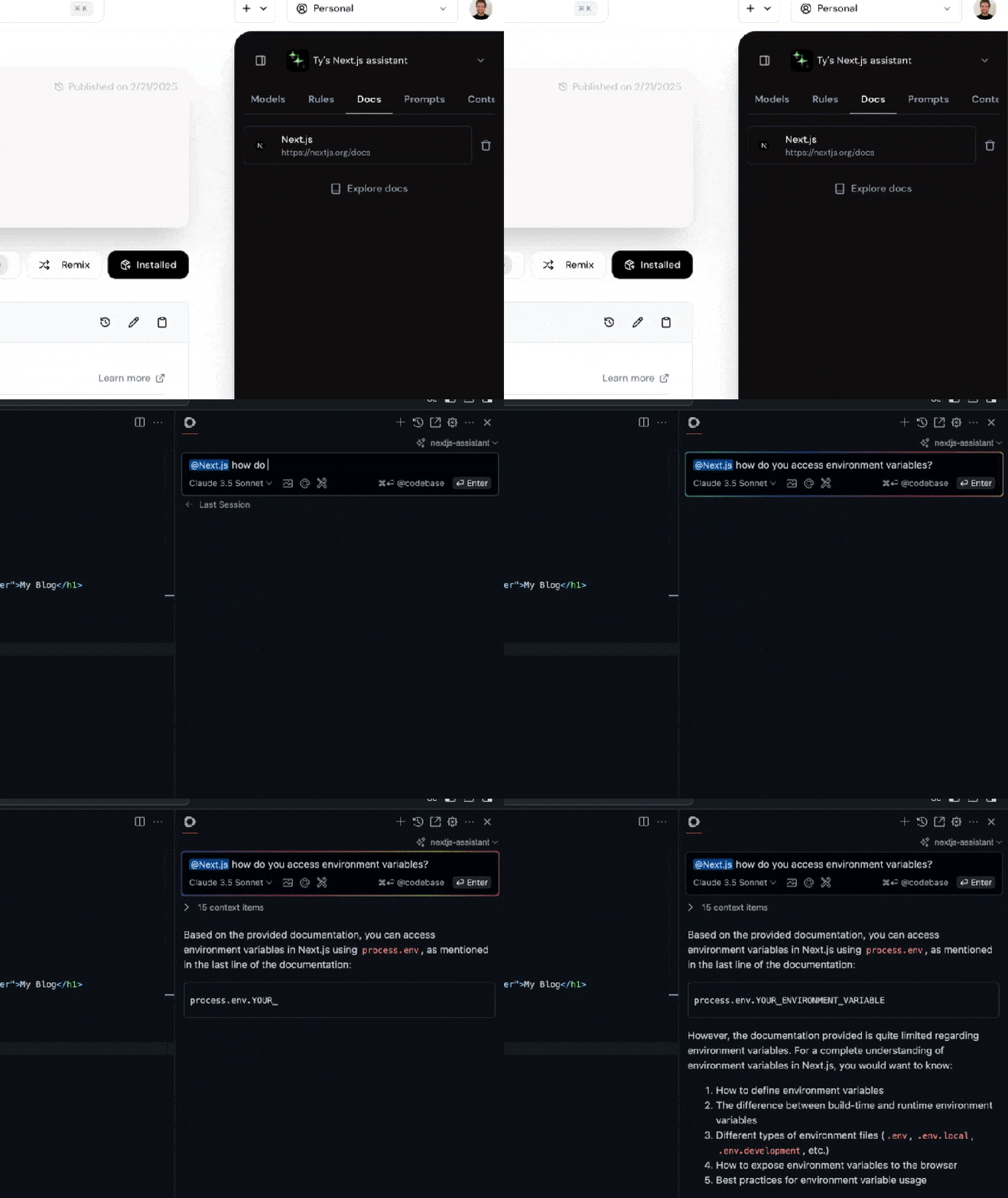
Today’s announcement highlights the initial “major” release of Continue’s open-source extensions for VS Code and JetBrains.
Dunn shared with TechCrunch, “This indicates to enterprises that this is a reliable project you can invest in and build upon.”
Alongside this, Continue is introducing a new hub, similar to Docker Hub, GitHub, or Hugging Face — a space for developers to design and share custom AI coding assistants, complete with a registry for defining and managing their various components.
At launch, the hub features pre-existing AI coding assistants, along with “blocks” provided by verified partners like Mistral with its Codestral model, Claude 3.5 Sonnet from Anthropic, and DeepSeek-R1 from Ollama. Individual developers or vendors can also contribute blocks and assistants to the hub.
A block might encompass models, specifying which AI model to employ and where; rules for tailoring the AI assistant; context to define the external context provider (like Jira or Confluence); prompts to encapsulate prewritten model prompts for executing complex instructions; docs to outline documentation sites (e.g., Angular or React); data, which enables developers to route development data to a specified endpoint for analysis; or MCP servers, stipulating a standard protocol for building and sharing tools for language models.

Fostering a “Culture of Contribution”
The vision behind this new hub is that most users won’t need extensive customizations — they will only require minor adjustments to the coding assistants or blocks already available in the hub.
This prompts the question: What motivates individuals to create customizations and share them with the broader community? The answer lies in the driving force behind open-source communities. Several launch partners are the very companies that develop the foundational tools or models (like Mistral and Anthropic), making Continue’s hub a prime opportunity to gain support from developers.
Furthermore, Continue’s mission is firmly rooted in the “open-source ethos.” If someone crafts customizations for their professional use, why not share it with the community at large? Ultimately, Continue seeks to stand in stark contrast to proprietary “black box” AI assistant solutions.
“This serves as a gathering point for the entire ecosystem to collaborate,” Dunn emphasized. “Instead of everyone creating their own closed-source AI coding assistant, what if we established an open architecture where all of us could collaborate to develop the building blocks necessary for tailored experiences?”
Dunn coins this approach as cultivating a “culture of contribution,” encouraging developers to innovate and generate customizations that provide value for all.
“With the launch of Continue 1.0, we empower a culture of contribution for developers to design and share custom AI coding assistants,” Dunn articulated. “This registry will serve as a discovery platform for organizations, evolving alongside the development of blocks and open, AI-enhanced developer tools.”
Another critical aspect is data control. In a generic “one-size-fits-all” platform, vendors can extract considerable insights by tracking how developers behave at scale and leverage this data to enhance the platform for everyone. Such practices have drawn criticism towards services like GitHub Copilot, which has been accused of exploiting the efforts of countless open-source software contributors for their own benefit.
With Continue, the premise is that organizations retain control over their data — they can choose to share as much or as little as they wish.
“Using Continue means your data remains yours,” Dunn affirmed. “As an organization, you can centralize all your data for your developers. This is not feasible with a generic, “black box” code assistant, which often aims to utilize your data for collective improvement.”
A Sustainable Business Model
Though Continue is still in its nascent stages, the startup asserts it has collaborated with several reputable businesses during its development phase — including Ionos, along with Siemens and Morningstar.
While larger enterprises are a significant focus, Dunn emphasizes that Continue caters to developers of all sizes, from freelancers and small teams to major enterprises. This broad approach outlines how Continue will generate revenue — its hub offers a complimentary solo tier, while organizations needing heightened data control can opt for paid access to enhanced administration, governance, and security features.
“There is substantial interest from larger companies, but we have also seen inquiries from individual developers looking for some customization. The solo tier should suffice for those scenarios,” Dunn stated. “However, as freelancers or small teams scale and require governance, they will transition to being paying customers.”
The solo tier offers three “visibility” options, allowing developers to keep their contributions private, share them within teams, or make them public. While technically usable in a team context, this tier lacks certain features essential for group collaboration. The separate “teams” tier introduces additional “multi-user” capabilities, alongside administrative controls for managing access to various blocks and assistants.
The enterprise tier, on the other hand, enhances the data, security, and governance features with more precise controls regarding the blocks, models, versions, and vendors utilized.
“Admins can also oversee security relating to credentials, determine data destinations, and access an audit trail detailing the who, what, when, and where of developer interactions,” Dunn elaborated.
Continue previously secured $2.1 million following its Y Combinator graduation in late 2023, and has now just raised an additional $3 million in SAFEs (funding with deferred equity distribution) led by developer-centric VC firm, Heavybit.
Dunn indicated that a majority of this new funding will be allocated to software engineering salaries, with plans to “at least double” the current workforce of five.
“By utilizing open source as a distribution channel, we’ve managed to keep our costs low — thus, our capital needs aren’t nearly as intensive as those of our competitors,” Dunn concluded.
Compiled by Techarena.au.
Fanpage: TechArena.au
Watch more about AI – Artificial Intelligence

