

On Thursday, Apptronik, a spin-off from the University of Texas that has been developing humanoid robots since before they became a trending topic, announced a successful Series A funding round, raising $350 million. Co-led by B Capital and Capital Factory, the financing also included contributions from Google, which is collaborating with Apptronik’s DeepMind division to advance embodied AI for bipedal robots.
“For Apptronik and the humanoid sector, 2025 will focus on showcasing meaningful applications with our early adopters and clients,” stated CEO Jeff Cardenas in an interview with TechCrunch. “By 2026 and later, we aim for true commercialization and scaling. This fundraise is intended to support that vision.”
Prior to this round, the Austin-based startup had secured a more modest total of $28 million. Cardenas noted that their earlier objective was to generate more revenue than the funds raised, a target they successfully achieved over the eight years since their inception. This revenue was largely generated through pilot projects—with companies like Mercedes and GXO Logistics—and direct robot sales. However, in the near term, their focus on growing revenue may be temporarily set aside.
Apptronik’s foray into humanoid robotics dates back to 2013, three years ahead of its official launch. This was when team members from the University of Texas at Austin’s Human Centered Robotics Lab participated in the NASA-DARPA Robotics Challenge, which featured a humanoid robot named Valkyrie. The partnership with NASA has remained strong as Apptronik has developed its own generation of humanoid robots, like the current model named Apollo.
Cardenas highlights their extensive experience in humanoid robotics—over a decade—as a key advantage over competitors like Figure, 1X, and Tesla. While Boston Dynamics and Agility Robotics also boast long histories, Apptronik brings a wealth of experience in this niche.
Google DeepMind
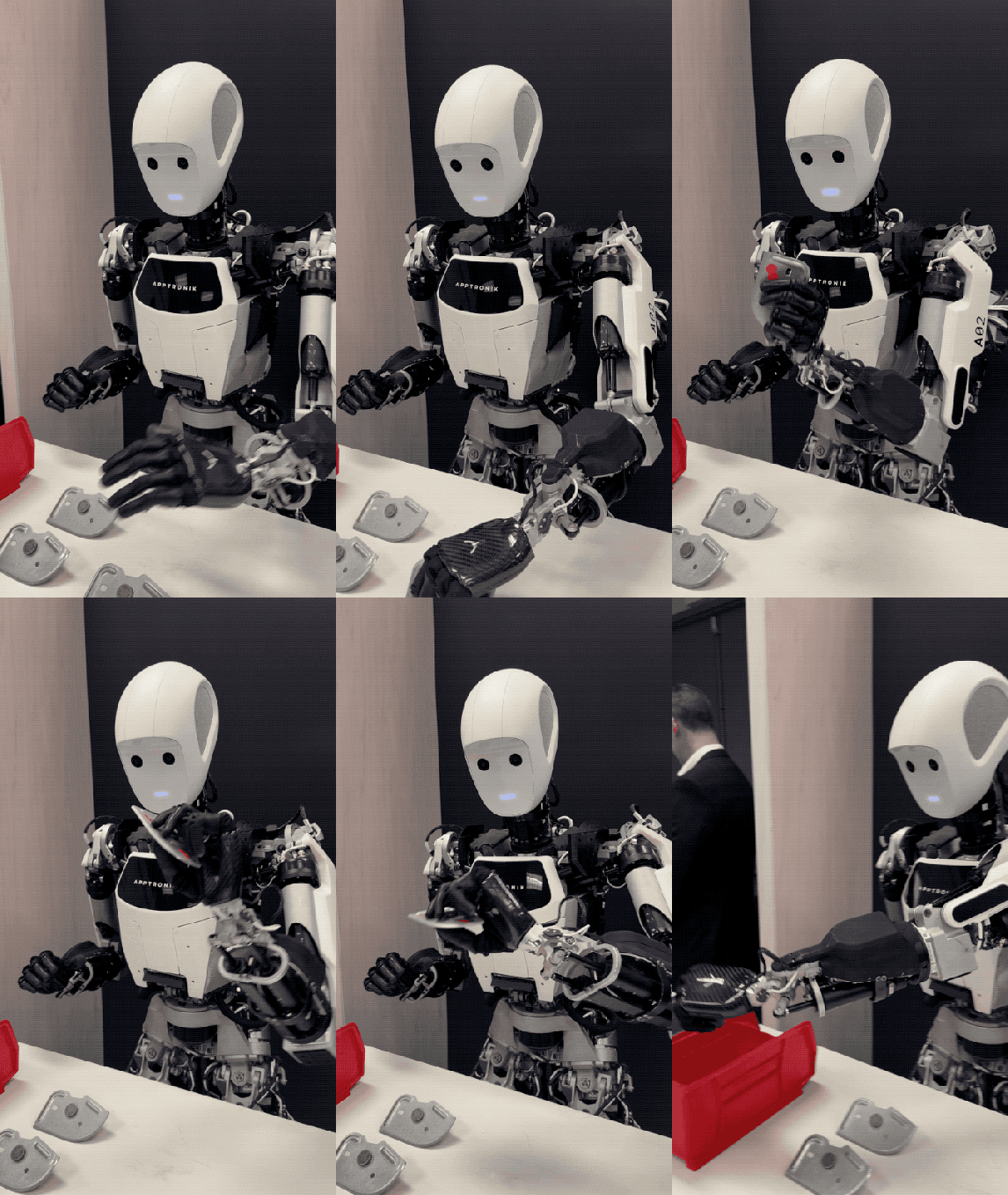
This extensive background may clarify why Google’s DeepMind AI team has chosen to partner with Apptronik to develop behavioral models for robots. Their “strategic partnership” reflects a broader trend within the industry; just last week, Boston Dynamics announced a collaboration with The Robotics & AI Institute, which follows another alignment with the Toyota Research Institute aimed at enhancing robot learning.
Such partnerships illustrate a significant trend in which companies, like OpenAI, have struck multiple deals in the robotics landscape. OpenAI has funded both 1X and Figure; last August, Figure revealed plans to employ OpenAI models to foster natural conversational capabilities for its 02 robot, although recent news indicated a shift to in-house AI development.
“To effectively deploy embodied AI at scale in real-world settings, vertical integration of robotic AI is essential,” stated Figure CEO Brett Adcock in a recent interview. “We cannot outsource AI just as we wouldn’t outsource our hardware.”
While Apptronik might eventually pursue a similar approach, a partnership with Google DeepMind aligns better with their current needs than the considerable funding needed to develop custom humanoid AI systems internally. “At present, we feel Google is leading the charge and producing some of the finest models globally,” noted Cardenas.
Putting robots to work

Central to Apptronik’s first funding round is the ambition for scaling and production. With a workforce of slightly over 170, the company plans to expand by approximately 50% in the coming year.
Despite the promising developments, Cardenas remains realistic about the timelines in an industry often criticized for overpromising. He informed TechCrunch that Apptronik has yet to move beyond pilot projects with any collaborators. While interest in humanoid robots surges, businesses must prioritize a careful approach that addresses safety and reliability before scaling operations.
Currently, Actpronik has multiple pilot projects, including its partnership with Mercedes, which is a logical fit considering the automotive sector’s pioneering role in such initiatives. These collaborations often focus on tasks requiring manual labor on the factory floor, such as moving totes. Similarly, Boston Dynamics works with its parent company Hyundai; Figure has deployed robots with BMW; and Tesla’s Optimus aims to assist in its own electric vehicle production.
Bringing it all back home

Similar to many competitors, Apptronik is exploring opportunities to deploy Apollo in settings beyond manufacturing and logistics. There may come a time when these robots assist at home by managing groceries, preparing meals, folding laundry, and more tasks that consumers may consider delegating to automation. Cardenas is particularly enthusiastic about innovations in age tech, considering it a significant potential application for advanced robotics. As the aging population increasingly opts for independent living, humanoid robots might play a supportive role.
“For me, the ultimate goal is age-tech,” Cardenas states. “I often consider where we can apply this technology to enhance the human experience.”
Nonetheless, that goal is still on the horizon.
For the time being, like most humanoid manufacturers, Apptronik’s attention is directed towards industrial applications. Factories and warehouses provide a pragmatic initial step, as these sectors possess the financial capabilities for pilot testing. Improvements in manufacturing scalability will contribute to reducing costs, although current systems remain prohibitively expensive for household or even care facility implementations. Cardenas reveals that Apollo’s target price is set below $50,000, but the company hasn’t reached that milestone yet.
“We are currently in a phase where the economics are beginning to align,” Cardenas observes. “We have identified pathways to develop significantly more affordable systems.”
Compiled by Techarena.au.
Fanpage: TechArena.au
Watch more about AI – Artificial Intelligence

