
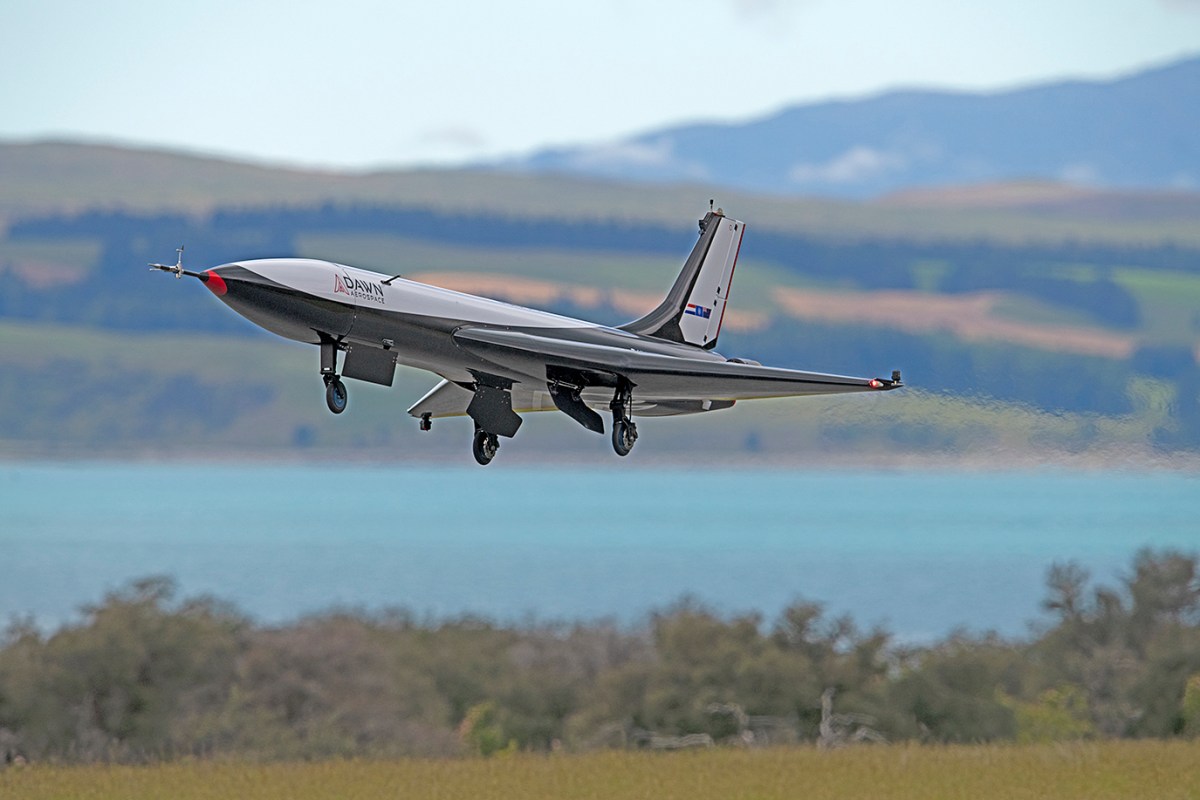
Dawn Aerospace has recently elevated the ambitions of aeronautical advancement with the elevated performance of its rocket-powered aircraft during its latest evaluation campaign. The enterprise is on course to possibly establish the most advanced aircraft ever to initiate flight from a conventional runway.
Accomplishing a trio of flights towards the end of July, the Mk-II Aurora apparatus notched up an impressive maximum velocity of Mach 0.92 alongside reaching altitudes of 50,000 feet. These achievements mark a significant threefold and fivefold enhancement from its antecedent trials. The forthcoming campaign, slated for a mid-September kickoff, aims to breach the barriers of supersonic travel.
The Mk-II serves as a precursor in the developmental lineage, charting a course for the Mk-III – an ambitious endeavor targeting a two-stage-to-orbit aircraft. It’s not difficult to forecast the demand for a contraption boasting the envisaged capabilities of what Dawn Aerospace refers to as Mk-IIB, the next evolution in their supersonic quest.
Ambitious goals were articulated by the company in a recent blog post, stating: “Our sights are set on surpassing an F-15 in ascent velocity, exceeding the operating altitude of a MiG-25, outpacing the velocity of an SR-71, and eclipsing a monumental aviation milestone; to be the pioneering vehicle to ascend beyond the Kármán line – a 100km altitude mark, universally acknowledged as the threshold of space, twice within the span of a single day. These records have remained unchallenged for over five decades.”
Dawn Aerospace sees its path carved out in two principal developmental and revenue-generating streams. The first leverages a vehicle with enhanced payload capabilities, aiming at remote sensing, Earth observation, and atmospheric science. The second track is propelled by a vehicle fine-tuned for high-velocity atmospheric flights, catering to hypersonic tests, point-to-point transportation, and microgravity studies.
“The vehicle designs we’re contemplating, though relatively compact, are tailored specifically to these applications,” exposed Dawn’s cofounder and CEO Stefan Powell during a recent discourse. “While we’re keeping the specifics under wraps – the what, when, and how – the Mk-IIB is poised as a versatile contender, bridging our engagement in the commercial realms of both ventures. Our current efforts involve active dialogues with potential clients interested in these innovative avenues.”
Dawn has secured upward of $15 million in capital and has judiciously allocated just $10 million towards its flight program endeavors, with a vision to encapsulate the entire project within a $20 million envelope. Although the firm garners revenue from its ancillary business in small satellite propulsion, the inflow from such investments remains modest, particularly for an aerospace entity at this juncture of progression.
This strategic approach starkly contrasts the developmental expenditure associated with analogous spaceplanes, hypersonic crafts, or vertical launch rockets. Powell attributes this frugality to the company’s ethos, as depicted in the blog post, preferring “an aircraft with the dynamics of a rocket, rather than a rocket adorned with wings.”
Given the high stakes tied with rocketry — where each mission mandates perfection, and anomalies could spell disaster — the company chose to anchor its philosophy in aeronautics. Drawing upon the aerospace tenure of cofounder and CFO, James Powell, and the industry’s hallmark of low operational costs, swift turnarounds, and reliability, the company steers its trajectory.
“Our journey thus far has been a testament to our ability to adapt swiftly and embrace the concept of an aircraft with rocket-like prowess rather than merely a rocket equipped with wings. This pivot presents a fundamentally superior operational framework,” he detailed.
“The notion of spaceplanes, such as the Shuttle, has previously encountered skepticism, deemed impractical. Similarly, endeavors involving winged structures, akin to Virgin Orbit, faced their challenges. The discourse surrounding air launch methods also met skepticism. To unravel the true essence of our vision compared to prior attempts requires a nuanced understanding of our pronounced emphasis on aviation principles, yet with the aim to cultivate rocket-grade performance,” he concluded.
Compiled by Techarena.au.
Fanpage: TechArena.au
Watch more about AI – Artificial Intelligence
