

Imagine this: you’re in the middle of a soothing warm shower when suddenly, the water turns icy, casting a shadow over your day.
Perhaps there was an unexpected demand for hot water in your home due to additional showers or laundry loads. It’s the classic dilemma of supply not meeting demand. Michael Rigney believes he has the solution to predict a household’s increased need for hot water, thereby ensuring warm showers without resorting to costly on-demand water heaters.
Rigney’s journey began several years back when he started exploring the dynamics of water heating. His findings were quite the revelation, he shared with TechCrunch in a recent conversation.
Despite being powered by gas or electricity, the fundamental design of most water heaters has remained unchanged for decades. While initially economical, their operational costs can accumulate over time.
The advent of heat pump water heaters has started to shift this, offering homeowners improved efficiency and reduced utility expenses. Nonetheless, Rigney saw significant room for enhancement,
In 2020, amidst the rising popularity of heat pump water heaters, Rigney established Cala Systems in Boston, spotting an entrepreneurial chance to develop a superior heat pump water heater model.
Water heaters are generally simple in structure, comprising an insulated tank, a heating element, and a thermostat. Most users set the thermostat once and seldom adjust it, except perhaps to temporarily increase the temperature for visitors. As the hot water is utilized, cold water refills the tank, reducing its overall temperature until the thermostat activates the heating element once more.
“That approach is outdated,” stated Rigney. “There’s room for advancement in 2024.”
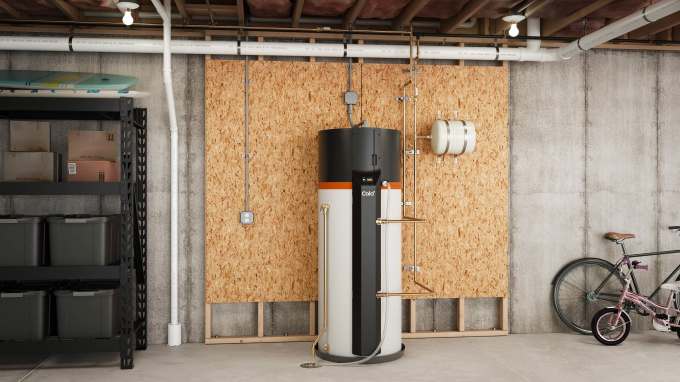
Cala Systems combines a sophisticated heat pump with an AI-driven control system to forecast and adjust to hot water demands, processing both general information like weather conditions and energy prices and specific household usage patterns, including the frequency of water use, temperature of incoming water, and the presence of solar panels. (Rigney assures that household data will not be commercialized.)
Through detailed analysis of water consumption trends, the system can predict periods of high demand and prepare by heating water more efficiently.
For instance, anticipating sunny days ahead, Cala’s system might capitalize on solar energy to pre-heat the water tank, blending hot with cold water to reach the desired temperature when needed, efficiently using excess solar energy. Alternatively, in stable weather and water usage conditions, the water heater could optimize its performance by decelerating the compressor, enhancing heat transfer efficiency by roughly 30%, according to Rigney.
And for occasions with extra guests, Cala has designed a boost mode that can be activated directly on the tank or via an app.
Currently, U.S. water heaters are almost evenly split between natural gas and electric models, with heat pump water heaters constituting a small but quickly growing segment, supported by incentives like those in the Inflation Reduction Act. Although more expensive initially, their operational efficiency offers long-term savings and reduced carbon emissions.
With plans to source components from various suppliers and assemble the final products in the U.S., Cala’s initial offering, a 65-gallon unit priced at $2,850, is set to hit the market soon, available for early next year delivery. While this model comes at a premium over its competitors, Rigney believes the savings in utility costs will cover this difference over time.
In anticipation of its launch, Cala has successfully raised a $5.6 million seed funding from leading clean energy investors, positioning itself in a burgeoning market with the potential to transform expectations around water heater functionalities.
Compiled by Techarena.au.
Fanpage: TechArena.au
Watch more about AI – Artificial Intelligence
