

An innovative AI technology for creating videos was introduced to the public today, yet it comes with limitations: It seems to restrict content that is considered politically delicate by the government of its country of establishment, China.
The system, referred to as Kling, is a creation of the Beijing-based enterprise Kuaishou and was initially given waitlisted availability at the start of the year to those possessing a Chinese telephone number. Now, it’s accessible to those who are willing to register with their email address. Upon registration, users are able to input descriptions and receive back five-second video renditions of their narratives.
Kling performs admirably as expected. The generated 720p resolution videos align closely with user prompts and take between one to two minutes to produce, demonstrating impressive physical dynamics simulation, such as the movement of leaves and the flow of water, comparable to other video generation models like Runway’s Gen-3 by AI startup Runway and OpenAI’s Sora.
However, Kling explicitly refuses to produce footage on certain topics. Requests regarding sensitive subjects like “Democracy in China,” or “Chinese President Xi Jinping on a casual walk” and the “Tiananmen Square demonstrations” are met with a generic error response.

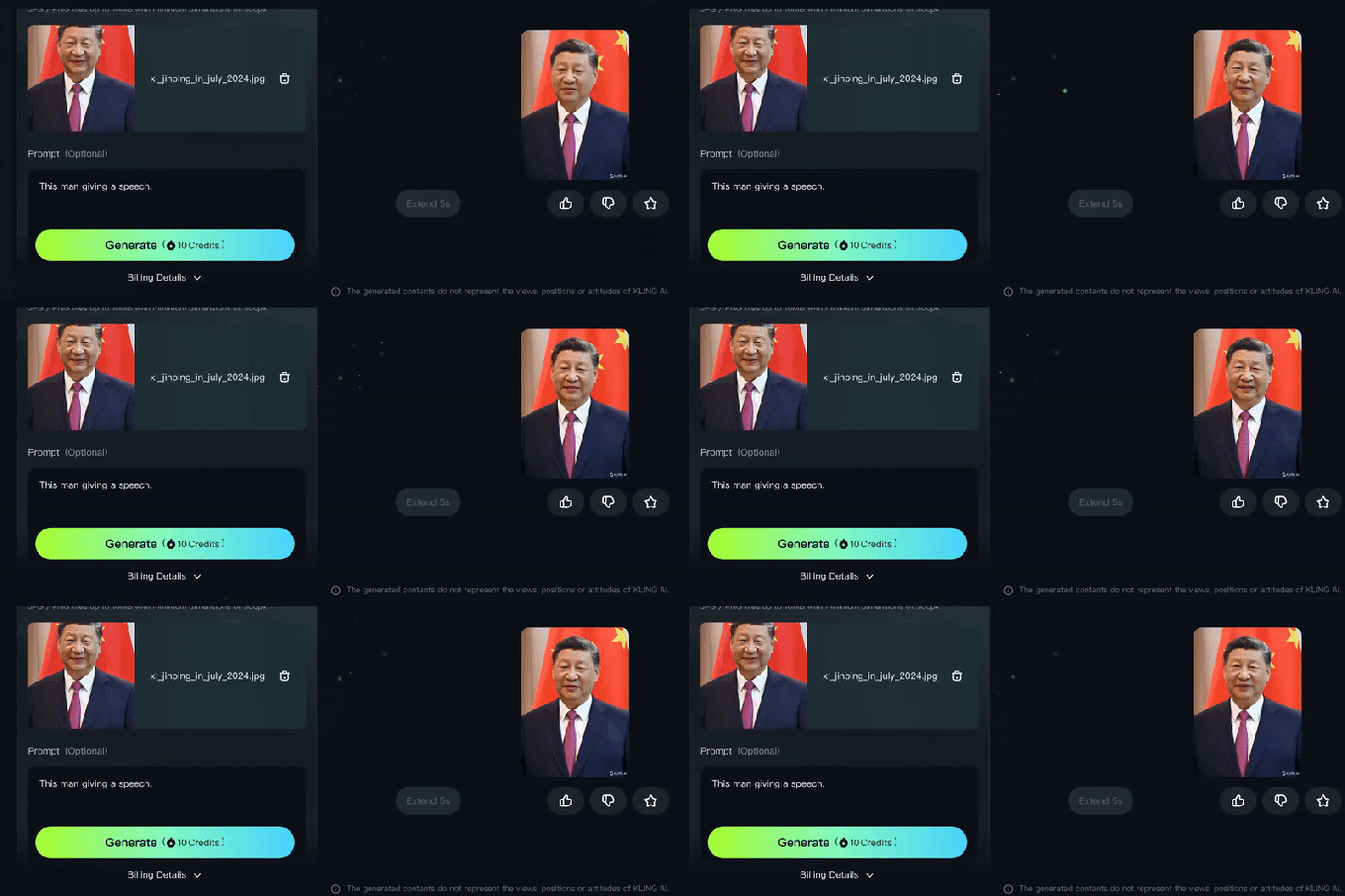
The filtering seems to be executed only at the input stage. Kling is capable of animating still images, including generating a video from a portrait of Jinping, provided that the text prompt does not explicitly mention Jinping by name (for example, “This individual delivering a speech”).
We have reached out to Kuaishou seeking their comments.
It is probable that Kling’s selective responsiveness is a consequence of significant political influence exerted by the Chinese administration on the development of generative AI technologies within the area.
In recent reports, the Financial Times highlighted that AI initiatives in China are subject to examination by China’s top internet regulator, the Cyberspace Administration of China (CAC), to verify their adherence to “core socialist values” in handling sensitive subjects. According to the Financial Times, these models are evaluated on their responses to a broad range of inquiries, including those concerning Jinping and the Communist Party critique.
Moreover, the CAC has reportedly proposed a prohibition list detailing sources that should not be employed in AI model development. Companies undergoing model evaluation are required to compile extensive sets of questions to assess the models’ capability to generate “safe” responses.
This results in AI technologies that opt to remain silent on discussions that could potentially provoke the Chinese regulatory bodies. Last year, a BBC investigation revealed that Ernie, the flagship AI conversational agent from Chinese tech giant Baidu, avoided and sidestepped interactions perceived as politically sensitive, such as inquiries about the situation in Xinjiang or Tibet.
These stringent regulations might hinder the progress of AI development in China, as they not only demand the removal of politically delicate information but also require significant development effort to establish ideological boundaries. These efforts, as shown by Kling, might not always be successful.
From the perspective of end-users, the regulatory environment in China is leading to a bifurcation in AI models: those that are significantly restricted by rigorous content filtering and others that experience less limitation. Is this dichotomy beneficial for the AI landscape at large?
Compiled by Techarena.au.
Fanpage: TechArena.au
Watch more about AI – Artificial Intelligence

