

A burgeoning enterprise that rivals GitHub Copilot and other automated coding aids has now joined the ranks of unicorns.
On Thursday, Codeium announced the completion of a Series C funding round, securing $150 million led by General Catalyst and post-money valuation pegging the company at $1.25 billion. This recent financial boost, with contributions from earlier backers Kleiner Perkins and Greenoaks, elevates Codeium’s total capital to about $243 million, a significant leap within just three years from its inception.
Varun Mohan, Codeium’s co-founder and CEO, shared with TechCrunch that the company has yet to utilize the $65 million raised from its Series B round in January. At that time, Codeium’s valuation was a mere $500 million.
“Despite the fact our previous funding remains largely untouched, we’re confident that this new capital will accelerate our research & development and growth plans, enabling us to pursue even more ambitious strategic initiatives,” he stated.
Founded in 2021 by Mohan and his childhood friend Douglas Chen, an MIT alumnus, Codeium embarked on its journey. Before this venture, Chen contributed to software development for VR headsets like Oculus Quest at Meta, while Mohan spearheaded the autonomy infrastructure team at Nuro, a trailblazer in autonomous delivery services.
Initially known as Exafunction focusing on AI load optimization and virtualization for GPUs, Mohan and Chen redirected their efforts to generative coding in 2022, rebranding the company in the process.
“Generative AI tools flood the market, yet developers remain bogged down by repetitive coding tasks,” Mohan elaborated. “Our AI-assisted coding solutions bridge the gap, offering custom code snippets that seamlessly integrate and secure within current projects, unlike the generic output of existing tools.”
Tailored by generative AI, trained on public datasets, Codeium’s service proposes code enhancements within the broader context of an application’s codebase, recognizes about 70 programming languages, and is compatible with several popular IDEs, including Microsoft Visual Studio and JetBrains.
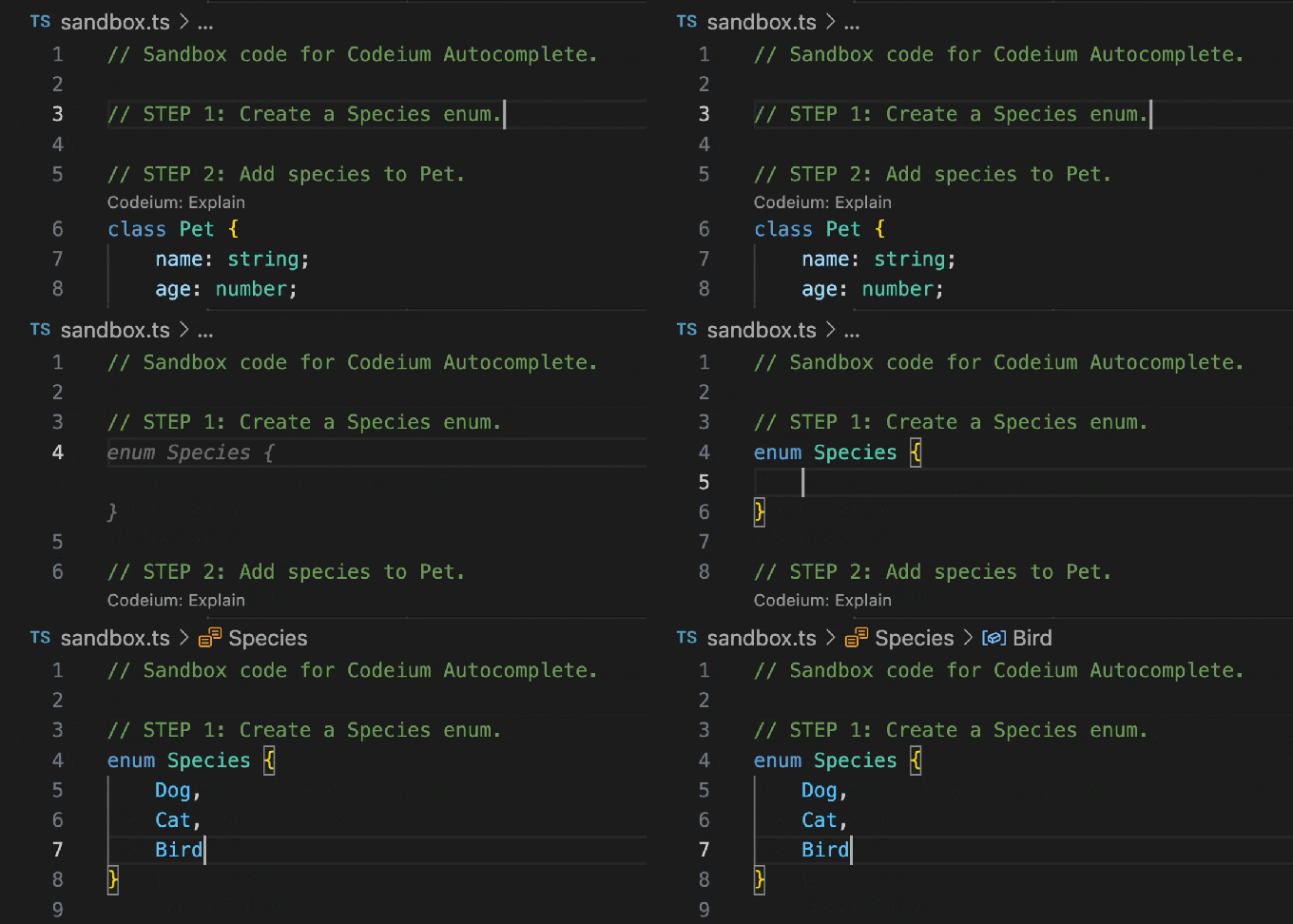
To divert developers from Copilot and its competitors, Codeium introduced an attractive free plan. Its effectiveness is evident as the company now boasts a user base of more than 700,000 alongside over 1,000 corporate clients, featuring Anduril, Zillow, and Dell.
General Catalyst’s managing director, Quentin Clark, hinted that Codeium’s significant contract wins could be attributed to its unwavering dedication to addressing client needs directly, leading to tailored solutions that operate seamlessly across any setup and support an unparalleled range of languages.
Given the hesitance of firms like Apple, which reportedly restricted Copilot usage due to data confidentiality concerns, Codeium introduced a self-hosting option to complement its SaaS offerings.

Businesses can either host Codeium’s engine on their infrastructure or opt for a mixed approach, leveraging their own servers for data storage and Codeium’s compute resources.
Highlighting the security aspect, Mohan assures that Codeium employs robust encryption techniques. “We’re committed to never utilizing user data for model training, nor do we sell it. All transmissions are securely encrypted,” he asserted.
Furthermore, Codeium meticulously purges its training datasets of any ‘non-permissively’ licensed code to avoid any legal quandaries related to intellectual property and copyright, distinguishing it from some code-generating platforms facing legal challenges over such issues.
“Additionally, we prune data resembling non-permissively licensed code to guard against potentially misattributed code. Our sophisticated post-generation process includes attribution filtering and logging, mitigating risks associated with inadvertently generating proprietary or copyrighted code,” Mohan added.
On the matter of ‘hallucinations’—false or inaccurate outputs from AI tools—Mohan reasoned that Codeium’s deeply contextualized technology generates more reliable and compliant suggestions compared to other services, despite the industry’s ongoing challenges.
As it made substantial inroads, attracting high-profile executives and achieving multi-million dollar revenues this year, the Mountain View-based venture, now employing 80 individuals, intends to scale its workforce to 120 by 2025, aiming to further penetrate a competitive landscape dominated by names like Tabnine, Anysphere, and Poolside.
Surpassing Copilot’s user base in the short term may not be feasible, but Codeium remains optimistic. Given the growing reliance on AI tools by developers, capturing even a fraction of this burgeoning sector promises significant returns. Polaris Research forecasts this market to swell to $27.17 billion by 2032.
“Navigating through the overwhelming hype is indeed a challenge,” Mohan acknowledged. “Yet, we’re convinced that entities anchored in realistic AI advancements, like Codeium, will stand out by consistently delivering genuine value.”
Compiled by Techarena.au.
Fanpage: TechArena.au
Watch more about AI – Artificial Intelligence

