
On a recent Sunday, ex-President Donald Trump shared a series of memes on his company’s platform, Truth Social, seemingly depicting Taylor Swift and her supporters endorsing his political campaign. However, with the introduction of new laws, these visuals raise significant concerns regarding the employment of AI-generated content in political promotions, particularly when they falsely represent a celebrity’s image.
“A trend I’m observing increasingly in my field is the surge of AI-generated impersonations for endorsements,” shared Noah Downs, an IP and entertainment attorney, with TechCrunch, stressing that his insights do not constitute legal counsel. The problem of fictitious AI endorsements has escalated to the point where “Shark Tank” felt compelled to issue a public service announcement alerting viewers about schemes that mimic the show’s judges.
In a notable image shared by Trump, numerous young females are seen donning “Swifties for Trump” apparel. While Swift’s fanbase does encompass a broad spectrum of political beliefs, these pictures seem to be the product of AI technology—originally stemming from a parody entry on X.
Another meme Trump disseminated shows an image from X picturing Taylor Swift as Uncle Sam, with the caption: “Taylor wants you to vote for Donald Trump.”
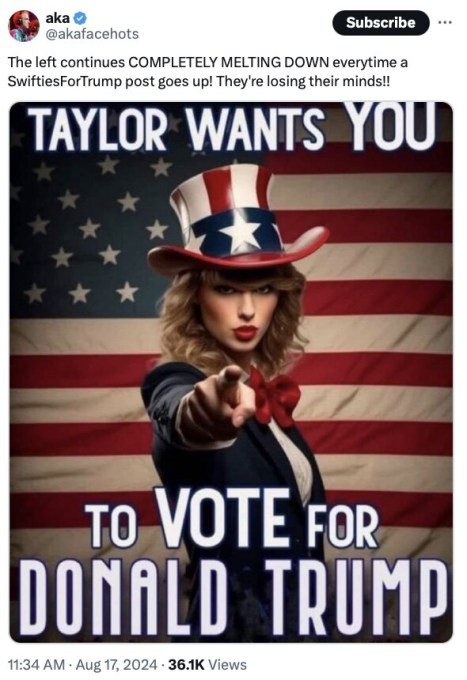
Though Swift has not publicly voiced her stance on the 2024 U.S. presidential race, she endorsed the Biden-Harris ticket in 2020 and openly criticized Trump back then. There was speculation about Swift subtly supporting Harris via an Instagram post earlier this month, but this was unfounded.
As a leading icon in pop culture, Swift has been a frequent subject of deepfakes. Upon the circulation of non-consensual, explicit AI imagery of Swift on X this year, legislators proposed new bills aimed at curbing deepfakes. White House Press Secretary Karine Jean-Pierre also urged Congress to take action.
Only eight months later, the environment surrounding legal safeguards against deceptive synthetic media has notably changed. In Tennessee, Governor Bill Lee enacted the groundbreaking ELVIS Act in March, providing artists explicit protection against unauthorized AI reproductions of their work.
“The bipartisan support for this law shows a common understanding of the challenges AI and its misuse pose to the public,” Downs commented.
However, with the ELVIS Act being quite new, it’s unclear how it might be leveraged to defend artists. The law’s wording largely concentrates on AI-generated audio that impersonates an artist’s voice, as seen in the widespread fake Drake track.
“This will undoubtedly be a long-standing challenge that the ELVIS Act ingeniously anticipates addressing, yet there’s a dire need for broader national policies,” stated Downs. Swift’s ties to Tennessee, via her business and property investments, might make the ELVIS Act particularly relevant in her case.
Avi D. Kelin, a PEM Law partner specializing in political law, expressed skepticism about the ELVIS Act’s relevance to imagery over vocal impersonations. He pondered whether this issue may rise as a concern for federal election integrity going forward.
“The key issue is whether the Federal Election Commission, responsible for overseeing political communications, will intervene,” Kelin shared with TechCrunch. He noted, however, that new FEC guidelines on AI-generated political content seem unlikely to emerge in this election cycle.
Conversely, the Federal Communications Commission (FCC) is advancing plans to introduce new AI transparency requirements in TV and radio ads. Yet, these don’t extend to social media posts by electoral candidates, despite social media’s crucial role in campaign communications. Research by the Center for Countering Digital Hate (CCDH) highlights a significant spike in AI-generated misinformation on X, averaging a 130% increase monthly over the past year.
These false endorsements are critical due to the immense cultural sway Swift holds, potentially influencing election outcomes. A Morning Consult survey revealed that over half of U.S. adults see themselves as Swift fans, with 16% being particularly enthusiastic. These figures are remarkable, considering about two-thirds of eligible American voters participated in the 2020 election.
“The [ELVIS Act] is quite fledgling, and the courts will need to delineate its exact application,” Kelin remarked. “This presents a fascinating potential case study!”
Compiled by Techarena.au.
Fanpage: TechArena.au
Watch more about AI – Artificial Intelligence
