

At its Made by Google event on Tuesday, Google shared exciting news about the debut of its Pixel 9 series in India. This marks the first appearance of the company’s new foldable device in one of the largest smartphone markets globally.
To widen its distribution network within the nation, Google is forging alliances with Tata Group’s Croma and Reliance Digital, a subsidiary of Reliance, in addition to its ongoing partnership with the online retail giant Flipkart. Google is also setting up three walk-in service centers to enhance customer service post-purchase.
Despite these efforts, the Android giant faces significant hurdles in India, where it holds a market share of less than 1%.
The launch of the Pixel 9 comes at a time when high-end product sales are on the rise in India, a shift that primarily benefits Apple. Apple has seen an 83% increase in its share in the ultra-premium smartphone segment (priced above $800), according to IDC data.
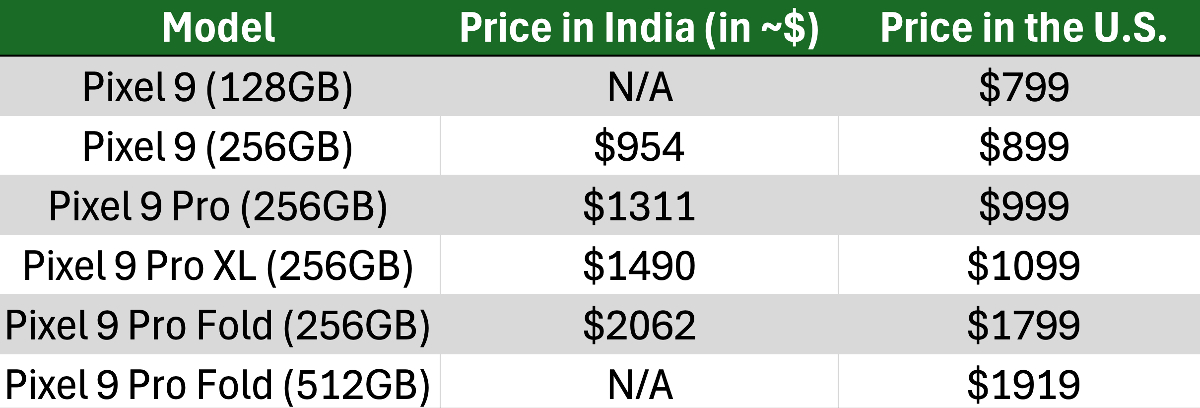
Targeting this segment, Google has priced the Pixel 9 series starting at 79,999 Indian rupees (approximately $950) for the base model, with the Pixel 9 Pro Fold priced at 172,999 Indian rupees (around $2,060). For comparison, the iPhone 15 starts at 79,600 Indian rupees (~$950), with its Pro Max variant reaching up to 193,500 rupees (~$2,300).
The narrative so far
Although Google’s Pixel phones have been available in India for years, it’s only recently that the tech giant began focusing on the Indian market more intently.
Google’s smartphone deliveries in India saw an extraordinary year-on-year increase of over 1,300% in 2023, soaring to 665,000 units from just 47,000 in 2020, as exclusively reported to TechCrunch by IDC. Nevertheless, Google’s share in the vast smartphone market of India remains modest at 0.5%, with the Pixel A series constituting 65% of its sales in 2023.
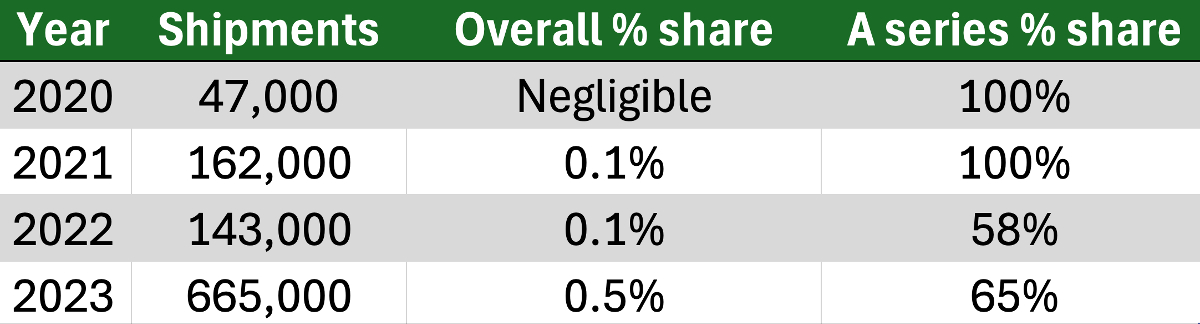
Despite the affordable pricing of the Pixel A series, its presence in India isn’t mainstream, with the Pixel 8a beginning at 52,999 Indian rupees (~$630). The leading segment in India is the entry-premium range ($200-$400), capturing a 30% market share, according to the analysis.
Counterpoint Research corroborates these insights, indicating that the Pixel range holds a 1% share in India’s premium segment and a 0.25% share across the entire market.
“The Pixel A series has facilitated Google’s expansion within the country,” Tarun Pathak, Counterpoint’s Research Director, mentioned to TechCrunch. “Its competitive pricing has enabled Google to reach a wider audience.”
Substantial marketing investments are crucial
In recent months, Google has been amplifying its presence in India. The company began local assembly of the Pixel 8 series, aligning with the Indian government’s ambition to establish the country as a key hub for global manufacturing. Enhancing its sales and after-sales network in India is also pivotal for Google.
Market analysts argue that for Google to effectively compete against major brands like Apple and Samsung in India, it must considerably increase its marketing investment.
“The upper segment of the market is experiencing robust growth, primarily led by Apple. However, there’s a noticeable rise in a consumer segment willing to invest in premium products. Google aims to capture part of this market with its advanced camera technology and AI-driven operating system. To achieve a noticeable market presence and consumer awareness, substantial, high-impact marketing investments are essential,” Navkendar Singh, IDC’s Associate Vice President, explained to TechCrunch.
Expansion of sales channels is necessary for Google to reach a wider demographic in India, where physical stores drive a majority of retail sales, Singh added.
“A purely online presence and limited physical stores won’t suffice in the long run for India, where consumers still prefer to physically examine products, especially in the high-end market. Google needs to penetrate the offline retail networks to attract consumers of premium Samsung products in top Indian cities,” he mentioned.
Starting with its initial offline partnerships in addition to its exclusive online partnership with Flipkart could offer some advantage to Google in broadening its consumer base.
“This strategy of leveraging multiple channels could potentially lead to increased growth and wider adoption of their products,” mentioned Pathak of Counterpoint.
Despite these strategies, forecasts suggest that the Pixel series might continue to occupy less than 1% of the market share in India, with the Pixel A models primarily driving Google’s growth in the region.
Pricing remains a significant barrier for Google in attracting a larger customer base in India, according to Singh.
“The pricing strategy seems misaligned and suggests that Google is aiming to maintain high profit margins,” he commented.
Google is also betting on the allure of AI features in its new Pixel phones to win over customers. Singh, however, maintains that consumers are not prioritizing AI features or delaying purchases in anticipation of them.
“In the medium to long term, AI functionalities will become a critical factor in the buying decision, particularly in the premium segment. This is likely to become even more pronounced if companies like Apple decide to incorporate on-device AI into their iPhones,” he concluded.
Compiled by Techarena.au.
Fanpage: TechArena.au
Watch more about AI – Artificial Intelligence
